
Date
2026
Location
Al-Khobar, Saudi Arabia
Date
2026
1. General Context and Form Generation
Al-Khobar was born facing the Gulf, in a landscape shaped by wind, currents, and horizon. Before the contemporary city, Al-Dawasir families sailed these waters in dhows, engaged in fishing, trade, and pearl diving. Navigating meant reading different signs and finding, between sky and sea, a possible direction. The project starts from that knowledge: to find one's bearings is to establish relationships.
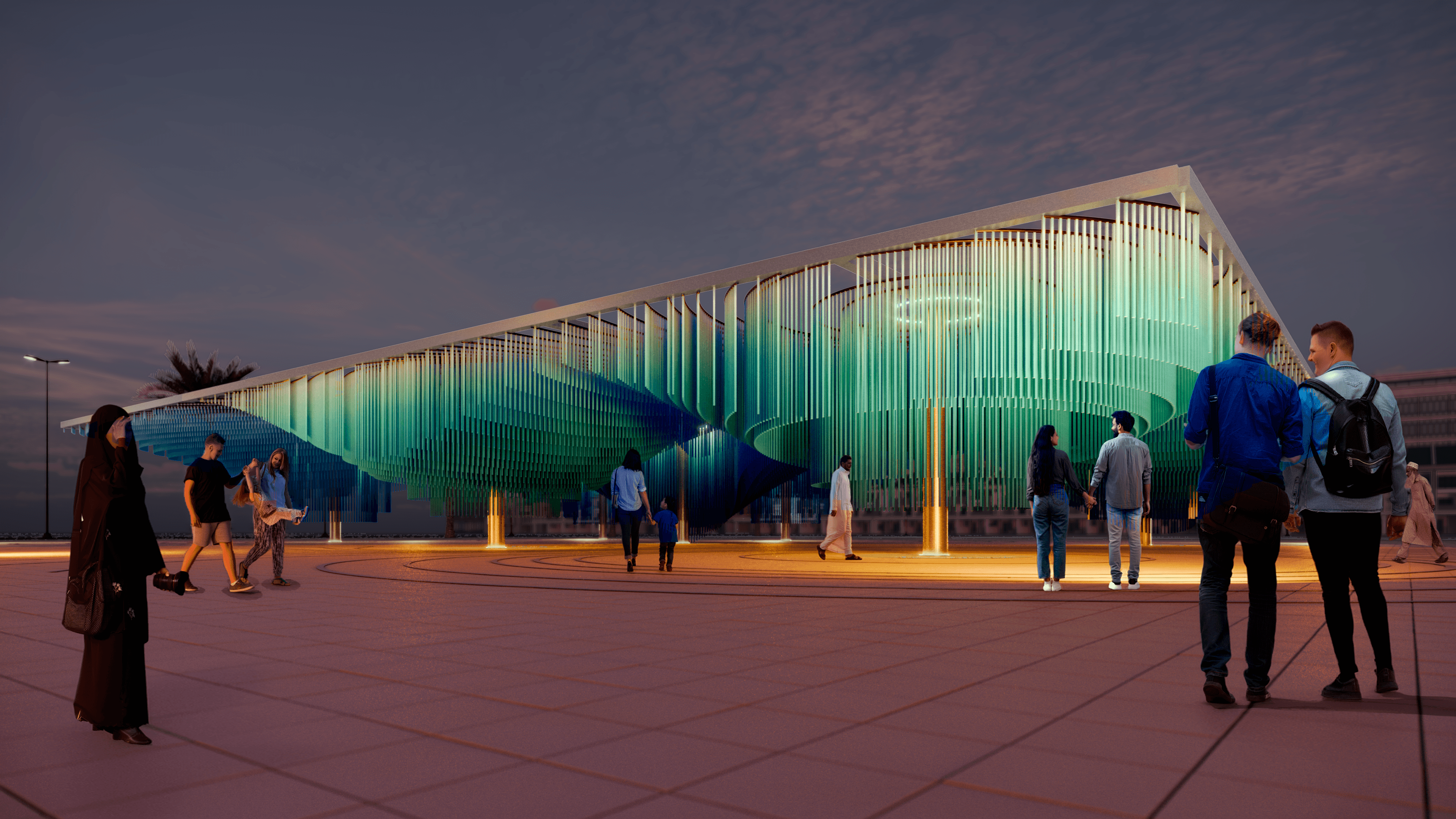
Seven pillars organize the work, one for each king of Saudi Arabia. Abdulaziz occupies the center as founder of the modern Kingdom. Around him, Saud, Faisal, Khalid, Fahd, Abdullah, and Salman mark the continuity of that history. Each pillar transforms the suspended elements around it, creating seven distinct centers within a single structure. The reigns do not appear as isolated monuments, but as parts of a shared field.
Beneath the canopy, thousands of vertical pieces form a suspended landscape. Their lengths and densities vary around the seven pillars, producing inflections that reveal themselves as one walks through. Seen from the Gulf, they recall the movement of water; observed from the city, they draw closer to the surfaces shaped by wind in the desert. Between these two landscapes, the form finds its place in Al-Khobar.
Astronomical navigation reappears as a principle of orientation. The pillars do not represent stars, but act as stable references within a space that changes as the visitor moves. At night, points of light associated with the seven cores may extend that reading, recalling the sky that guided the Gulf's navigators. On the ground lie the paths; above, the references that make them possible to find.
2. Form generation
The suspended form and the floor flows grow from the same system: fields of influence projected from the seven pillars, which determine the length and density of each vertical piece above, and the layout of the lines on the floor below. On the floor, these curved lines register the influence of the pillars and guide the visitor through the whole. They approach, drift apart, and cross like routes traced on a nautical chart. The rings around each support identify the seven kings and turn the passage through the monument into a reading of history. There is no obligatory route. Each person chooses how to cross this field and from where to observe its relationships.
The work is perceived in motion. The repetition of the pieces filters the light, alters the density of the space, and frames different views of the city and the sea. From afar, the canopy forms a continuous landmark on the corniche. Up close, it becomes a place of passage, pause, and encounter, where the monumental scale draws closer to the body.
3.Structure and Materials
The work is supported by a metal structure: circular columns with a 20 cm radius, topped by an upper mesh 10 cm high, organized in a 25 m by 35 m rectangle and divided into 5 m by 4.20 m modules. From this mesh hang the thousands of vertical aluminum pieces, allowing the canopy to appear to float above the passage below. The columns remain discreet in scale and material, and all fixings and lighting electronics stay accessible at their base, away from the sea spray.
The suspended curtain is made of thousands of vertical aluminum profiles, 2.8 cm by 2.8 cm in section, finished in the white to blue gradient. The floor is executed in terrazzo: a beige base, generating lines in gray blue terrazzo, and rings around each pillar in dark terrazzo, where each king's name is engraved and lit.
4. Identity and Pulse
The piece's daytime visual identity is stable and timeless. By day, the sculpture reads as a frozen wave, anchored to the site's maritime landscape, independent of any technical system. The finish follows a fixed chromatic gradient, from white at the top to the deep blue of the Arabian Gulf at the lower tips, a direct reference to the water, sky, and horizon that define the Tharwa Sea Front.
At night, that same form gains a second layer of reading. External light fixtures, positioned at the base of the pillars and integrated into the upper mesh, graze light upward and inward across the vertical profiles. The light is raking: it lights one face of each piece, leaves the other in shadow, and bleeds through the gaps between them, creating a volumetric effect.
This light is driven by real urban data, organized in layers that do not compete with one another because each acts on a different parameter of the same reading. An ambient pulse layer changes slowly through the night: the tide of the Gulf controls how high the glow rises through the profiles from the base, so a high tide pushes the light further up the suspended “wave,” and a low tide keeps it concentrated near the ground, as if the piece breathed to the same rhythm as the water that inspired it. Above that height, air quality controls the color temperature: clean air keeps the light in a cool blue white, reinforcing the daytime gradient; higher dust or pollution shifts the tone toward a warmer white, a subtle signal, not an alarming one, of how the city's air is that night.
Over this ambient pulse, a second layer introduces brief events. At the five prayer times, a gentle wave of golden light sweeps across the whole canopy over a few minutes, like a single breath, then returns to the ambient state. On dates from the national and Hijri calendar (National Day, Founding Day, Ramadan), the piece enters a special lighting mode for a longer period, temporarily overlaying the day to day reading.
Fixed by day and dynamic by night, the piece physically performs the transition between tradition and innovation: the color of the aluminum anchors the memory of the Gulf, and the light that rises through it, guided by tide, air, prayer, and calendar, is the living pulse of the city over that same form, every evening, in front of those walking along the Corniche.
The project turns history into an experience of orientation. Above, seven centers give shape to the suspended field. On the ground, its lines mark possible paths. Around it, the horizon keeps the relationship with the Gulf open. Abdulaziz establishes the origin; the six kings who followed him extend that structure through time. Between them, each visitor finds their own bearing.
Keywords: Public Space Competition