
Date
2026
Location
São Paulo, Brazil
Date
2026
Bixiga Park is conceived as a surgical incision into the urban fabric, revealing hidden ecological, hydrological and cultural layers to transform the site into a hybrid space that intertwines infrastructure, landscape and social activity. Through precise cuts, accessible ramps and a network of connections, the project stitches together urban fragments, linking neighbouring neighbourhoods, the upper city to the lower landscape and the Teatro Oficina to a wide open space, dissolving boundaries between circulation, culture and ecology in a sequential experience of discovery that makes this region a territory that is both exposed and reimagined.
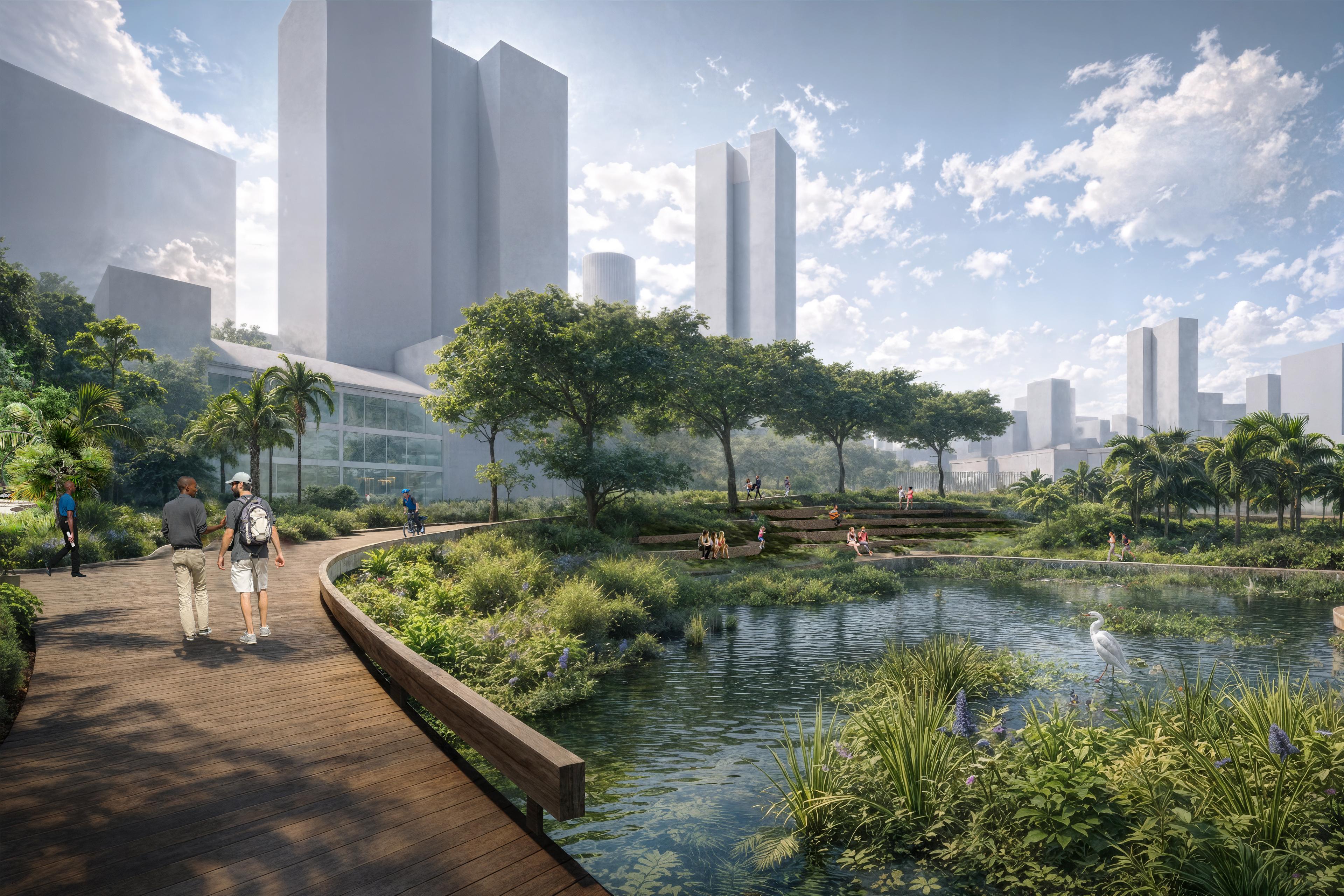
The new site emerges from a landscaping project that exposes buried subsoil, reworking existing debris—such as concrete and retaining walls—into terraces, open spaces and habitable thresholds, inviting people to explore geological strata and ecological processes as if in a living museum of the soil. Thus, we reveal a hydrological machine, now visible, which displays its processes of water infiltration, filtration, retention and overflow, with floodable terraces, an amphitheatre adaptable to seasonal cycles, catchment basins, artificial wetlands for restoration using native species, an irrigable children’s playground that uses water as a playful tool, and a Citizen Observatory, with sensors that make the hidden flow of the Bixiga Stream visible, extending its riverside narrative through interpretative interventions and respecting the past which, rather than being erased (or filled in), is instead reconfigured.
In this way, we offer the public ecological refuges, social spaces, performance platforms and other alternatives for the active use of space, which combine to form an integrated ecosystem with varying degrees of intensity, welcoming everyday life, spontaneous moments and events, whilst a dense canopy forms a woodland that generates cooling microclimates, shade and climate resilience, contrasting lush vegetation with raw geological exposures. Added to this is a tribute to Teatro Oficina: the park offers an extension that expands the performance space into an open-air amphitheatre connected to an area for wellbeing and contemplation created from demolition materials—that is, through productive and recycling-based reuse—which opens up to serve as a stage for community events.
Finally, by prioritising nature-based systems such as rain gardens, infiltration trenches, floating islands, permeable pavements and rain terraces, we have redesigned the blue-green infrastructure to restore the natural habitat for flora and fauna, prioritising local species, in order to mitigate flooding and urban heat, not only optimising infiltration by up to 70% of local rainfall but also making visible the transformations of the space through water and seasonal cycles. In this way, the park evolves through community participation, consistent structures and continuous ecological processes, creating a performative ground that transforms submerged commons into a sense of belonging and reaffirms Bixiga as a living territory of collective agency.
Keywords: Public Space Competiotion